

Fra Diego La Matina: A man of "unyielding resolve"
Fra Diego La Matina: A man of "unyielding resolve"
Diego La Matina, born in Racalmuto in 1622, entered the convent of the Reformed Augustinians at a very young age. He was the central figure of a long and harrowing ordeal that inspired Leonardo Sciascia’s book, Death of the Inquisitor.
First tried in 1644 by the Royal High Court (Regia Gran Corte), he faced two further trials by the Tribunal of the Inquisition that same year and the following one; in both instances, he was acquitted after pronouncing a formal abjuration. Leonardo Sciascia was of the opinion that such leniency from the tribunal confirmed the hypothesis that Friar Diego’s heresy was more social than theological. In 1646, he was tried for a third time: the tribunal sought to punish his obstinacy, if not his heresy. Friar Diego was sentenced to five years of deportation to the galleys.
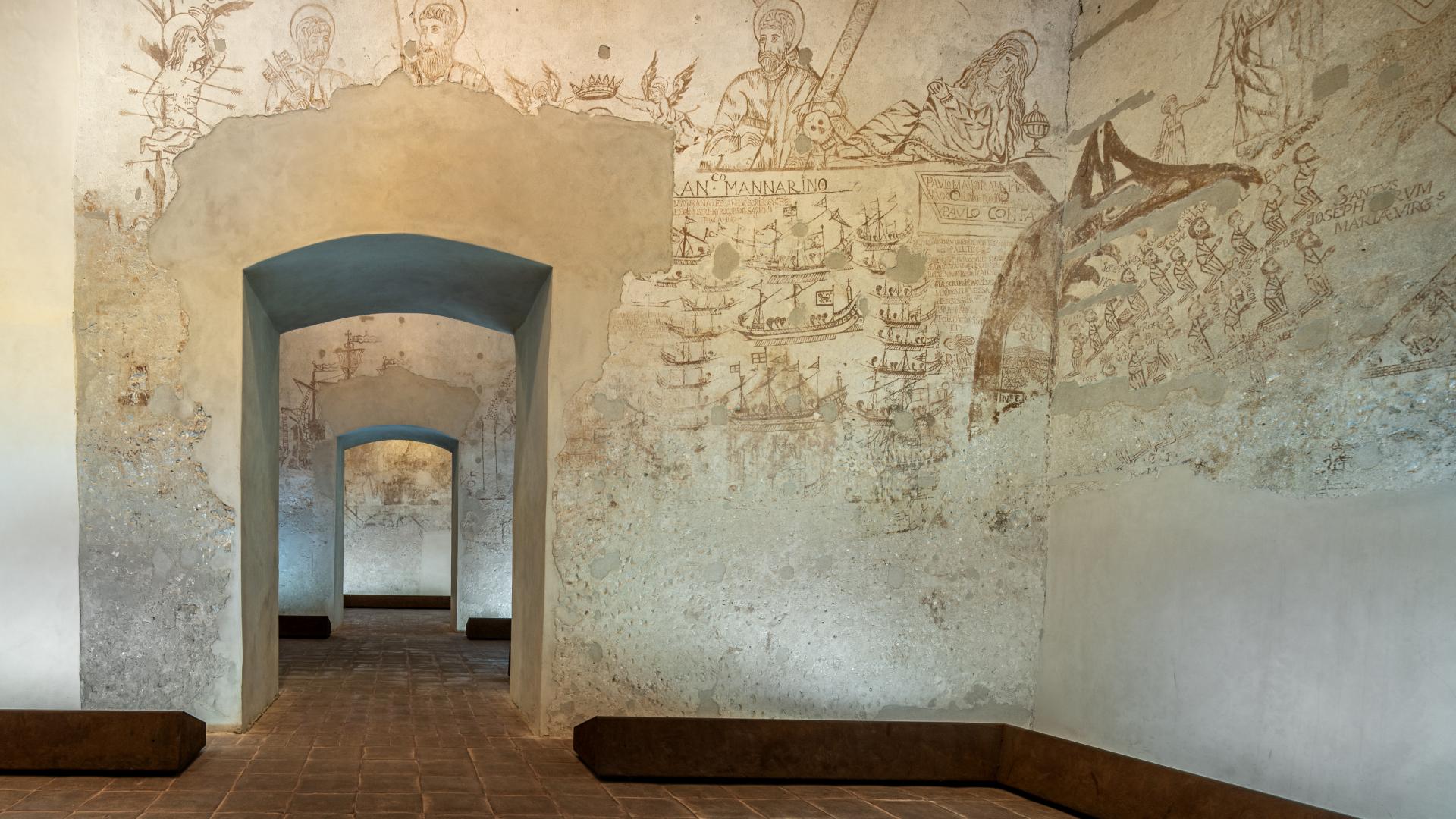
On August 7, 1649, he most likely organized a protest that led to a mutiny. This time, with a sentence handed down in 1650, a most severe penalty was imposed upon him: "to be immured in perpetuity within a single room." During his confinement, "more than once did he attempt to take his own life, unconcerned by eternal torment, by abstaining from food for many days."
He escaped from the Steri prison in 1656 (“to the wonder of those who saw the place and heard the tale, he broke through the thickest wall of the secret dungeons and fled with the cord of the torture rack, which he found in a certain place”), taking refuge in the countryside of Racalmuto, in the district and the cave that now bear his name. After a few days, he was captured and returned to the Inquisition prisons of the Holy Office in Palermo. He was repeatedly subjected to torture; particularly atrocious was the "rack" (cavalletto), which resulted in dislocations of his shoulders, knees, and wrists, and the tearing of his muscles.
On March 24, 1657, during an interrogation, Friar Diego mortally wounded the Inquisitor Juan Lopez de Cisneros. The account of that day was provided by Inquisitor Pablo Escobar in a letter to the Inquisitor General of the Supreme Court in Madrid on July 10, 1657. For the murder of Monsignor de Cisneros, Friar Diego was sentenced to be burned at the stake. The execution took place on March 17, 1658, in the Piano di Sant’Erasmo.
Sciascia, citing the contemporary chronicler Girolamo Matranga regarding the dispute with theologians that preceded the night of the execution, writes:
«It is one of the most atrocious and harrowing scenes that human intolerance has ever staged [...] men filled with theological and moral doctrine, who torment the condemned man, remain in the history of human dishonor; Diego La Matina asserts the dignity and honor of man, the power of thought, the tenacity of will, the victory of freedom.» [...] He was no ignorant man: he disputed with the foremost theologians of Palermo; for months, for years, amidst blandishments and under torture, he rejected their persuasions and countered their arguments with his own. And in the final hours of his life, he exhausted ten of them: ten learned theologians, refreshed from time to time by the kitchen and cellar of the jailer, were worn out by a man whose body and mind had endured fourteen years of the harshest and most atrocious trials; by a man who for months, even in that moment and until his death by fire a few hours later, remained bound with iron shackles to a sturdy chestnut wood chair [...]. Are we blinded by love and the honor of belonging to the same people, of having been born in the same land, if we recall that he did not change his expression, nor move his neck, nor bend his side?
Once the sentence was pronounced, he was placed on an ox-drawn cart and taken to the Piano di Sant’Erasmo, where the pyre had been prepared. «At the sight of the stake, Friar Diego did not falter, was not dismayed, and showed no signs of fear or dread.»
After being placed on the pyre, still bound to the chair and the chair tied to a stake, Friar Diego said he wished to speak to the Theatine Giuseppe Cicala, one of the two fathers who had accompanied him: «I will change my judgment and my faith, and I will submit to the Catholic Church if you give me corporal life» said Friar Diego. The Theatine replied that the sentence was unchangeable. And Friar Diego: «Why then did the prophet say: Nolo mortem peccatori, sed ut magis convertatur, et vivat?» — And when the Theatine replied that the prophet meant spiritual life and not corporal life, Friar Diego said — «Then God is unjust.»
These words, which Sciascia—to whom we owe the reconstruction of these events—considers «not as a sign of yielding or fear on the part of the condemned; but as the ultimate way to prove to the people the inflexible ferocity of a faith that claimed to be inspired by charity, mercy, and love.»