

Botanical Garden
A historical collection of charcoal filters (19th–20th centuries): a new acquisition
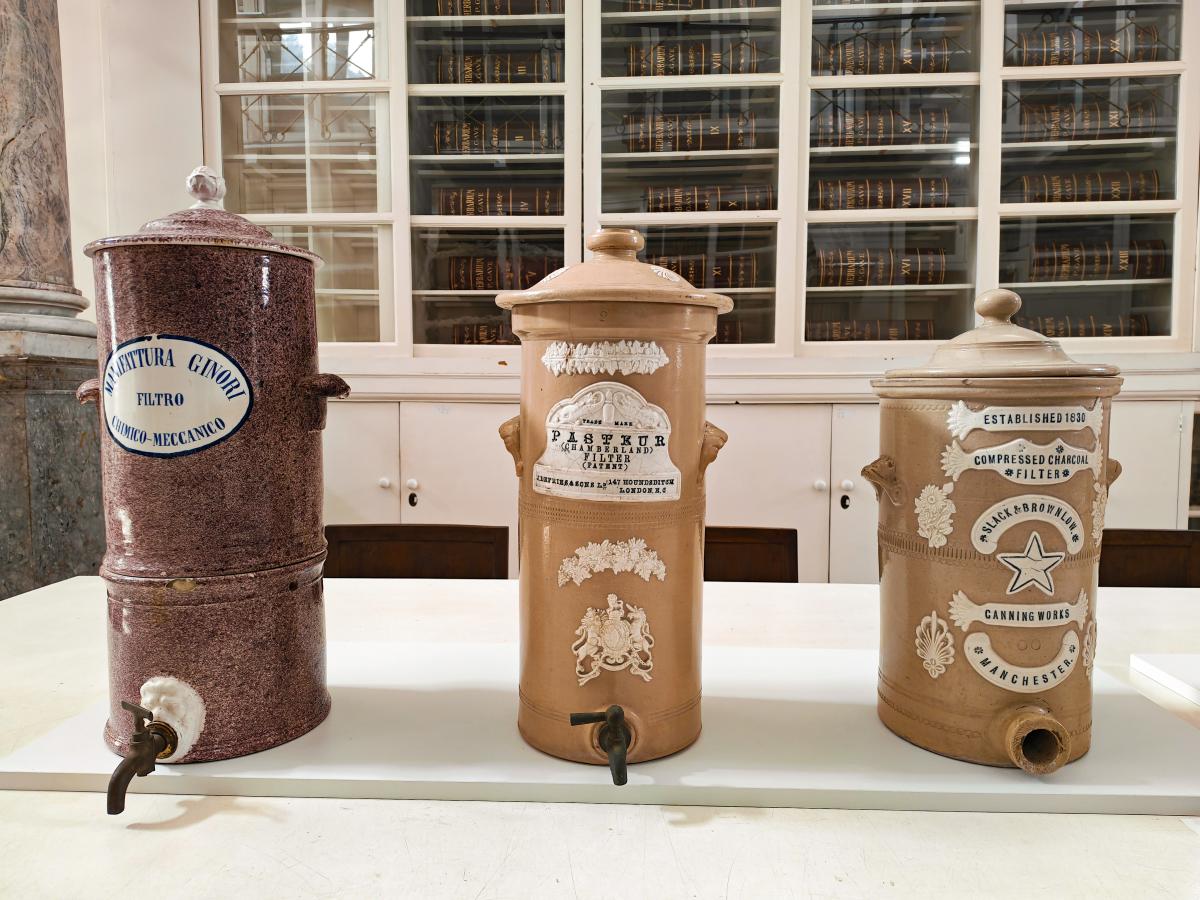
The University Museum System is delighted to announce the acquisition of a rare historical collection of six water purification charcoal filters, made of porcelain and stoneware, which provide vital evidence of the technical evolution of water purification between the 19th and 20th centuries, on exhibition at the Historical Herbarium of the Botanical Garden.
These objects are not merely precious ceramic artefacts, but represent the technological response to the major cholera and typhoid epidemics that struck industrial cities such as Manchester and London during the 19th century.
The turning point in water purification
In the 1800s, increasing industrialisation severely polluted urban water sources. Charcoal filters marked a crucial turning point in water purification, evolving from simple domestic methods into increasingly sophisticated systems. The solution came from the ingenuity of master potters such as John and Henry Doulton, who invented an advanced system of gravitational water filtration ingeniously constructed using ceramic pipes and charcoal (a purifying substance already known to the Romans).
- 1827: John Doulton creates the first stoneware containers with layers of powdered charcoal. Modern gravity filtration is born to combat industrial pollution.
- 1861: Queen Victoria orders Doulton filters for her residence in Westminster. Water hygiene becomes a national priority and a status symbol.
- 1862: Henry Doulton invents the ‘Manganous Carbon Filter’. It is the first cartridge system featuring stacked blocks of carbon screwed into the base of a sandstone basket: its antibacterial efficiency reaches 99%.
- 1860–1880: Companies such as W.M. Jowett and Slack & Brownlow launch reverse-flow “Self-Cleansing Carbon Filters”. Victorian stoneware becomes the standard for domestic water purification.
- 1880–1890: Maignen’s ‘Filtre Rapide’ triumphs at international exhibitions. In Italy, the Ginori Manufactory adapts the technology for artistic majolica.
- 1905: Introduction of the porous porcelain tube, or ‘candle’, for water filtration, which becomes standard in hospitals and laboratories worldwide.
How did they work?
The filters exploited the porosity of activated carbon to act as a mechanical and chemical sponge, trapping particles, sediments and organic substances responsible for bad odours and diseases. Many models, such as the ‘Self-Cleansing’ filters (1860–1880), were already designed with backwash systems to clean out deposits, anticipating modern maintenance systems. The transition from domestic filters to stacked and screwed ‘charcoal blocks’ marked the shift from artisanal production to modern sanitary engineering.
Items in the collection
The acquired collection boasts examples of exceptional stylistic and technical value:
1. W.M. Jowett & Co. Sanitary Filter
- Place of manufacture: Manchester, United Kingdom (second half of the 19th century)
- Material: Porcelain stoneware | Height: 56 cm
- Historical notes: Features the ‘St George Slaying the Dragon’ mark and the ‘Sanitary Filter’ stamp. The Manchester-based company was a leading name in Victorian hygiene between the late 19th and early 20th centuries.
2. Maignen’s “Filtre Rapide”
- Place of manufacture: London, United Kingdom (second half of the 19th century)
- Material: Glazed earthenware decorated with decals | Height: 45 cm
- Historical notes: Founded in 1880, Prosper Auguste Maignen’s London-based Maignens Filtre Rapide and Anti-Calcaire Company became renowned for the efficiency of its systems, such as the “Filtre Rapide” (Rapid Filter), in military and industrial contexts, receiving numerous international accolades for its sanitary innovations.
3. Berkefeld Filter Gesellschaft G.M.B.H.
- Place of manufacture: Celle, Germany (early 1900s)
- Material: Glazed earthenware with Art Nouveau decoration | Height: 56 cm
- Historical notes: Invented in 1891 by the German engineer Wilhelm Berkefeld, it uses diatomite (diatomaceous earth) as a filter layer. This model combines the effectiveness demonstrated during the Hamburg cholera epidemic (1892) with a refined Art Nouveau aesthetic.
4. Slack & Brownlow Compressed Carbon Filter
- Place of manufacture: Manchester, United Kingdom (mid-19th century)
- Material: Porcelain stoneware | Height: 46 cm
- Historical notes: Manufactured at the Canning Works in Manchester from 1830 onwards, these filters were renowned for export to warmer climates. They feature typical period decorations such as lion-head handles, floral or fern-shaped reliefs, and a tap.
5. ‘Pasteur’-Chamberland-type filter (J. Defries & Son)
- Place of manufacture: London, under French licence (second half of the 19th century)
- Material: Porcelain stoneware | Height: 51.5 cm
- Historical notes: Based on the 1884 invention by Charles Chamberland (assistant to Louis Pasteur). It is a revolutionary device made of porous porcelain capable of eliminating bacteria and microorganisms, marketed in London by the firm Defries & Sons, which obtained the licence to produce it, contributing to its widespread use during the Victorian era.
6. ‘Ginori Manufactory’ Mechanical Chemical Filter
- Place of manufacture: Doccia (Florence), Italy (second half of the 19th century)
- Material: Decorated majolica | Height: 58 cm
- Historical notes: A testament to the eclecticism of the Ginori Manufactory. It features a refined purple decoration ‘in the style of porphyry’, a blue oval scroll and a tap spout in the shape of a lion’s head in white-glazed bas-relief. At the top are two small winged sockets.


